
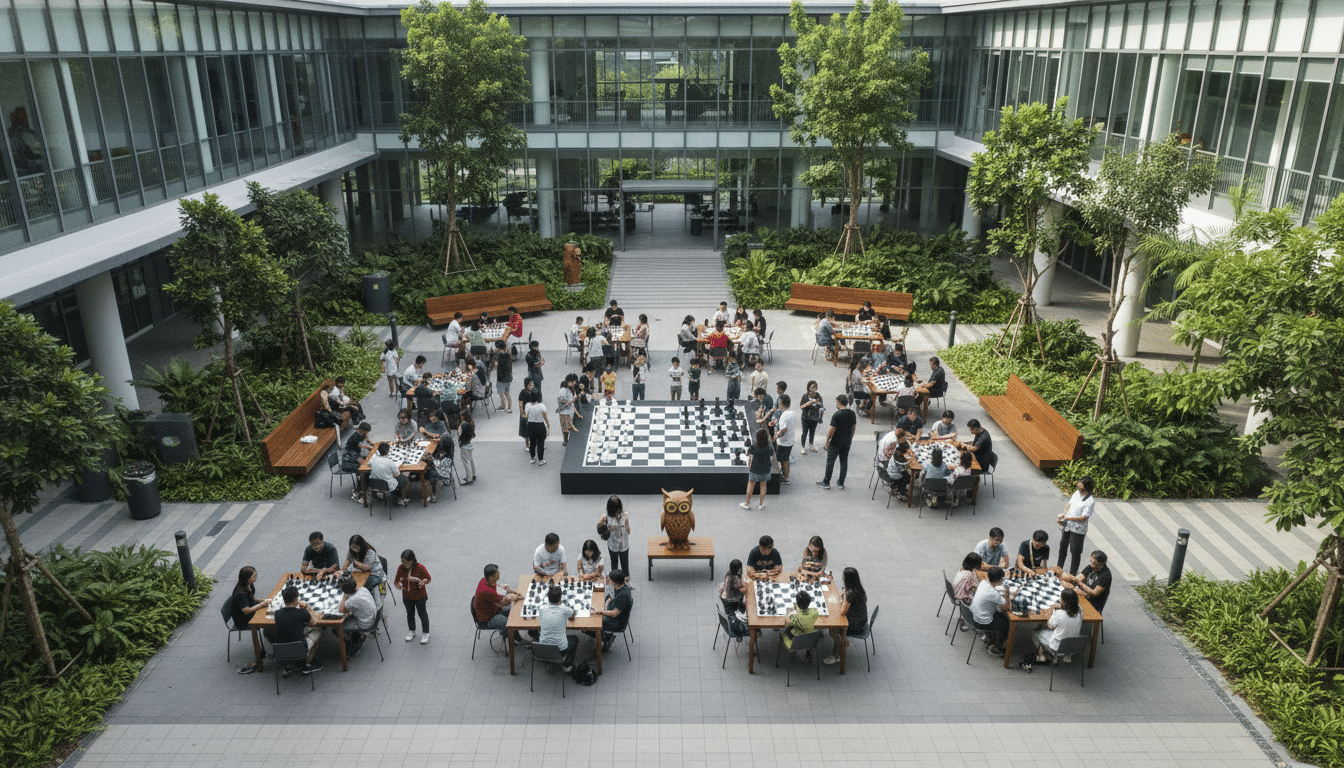
A delegation from the FIDE Chess in Education Commission visited the Overseas Family School (OFS) in Singapore to study how the school embeds chess into everyday learning. The trip is part of preparations for 2026, which FIDE has designated the Year of Chess in Education, and aims to gather proven ideas that can be adapted and scaled in other school systems.
Significance of Chess in Educational Settings
OFS, an international K–12 school with about 3,000 students from more than 70 countries, is widely seen as a benchmark for using chess to build classroom skills such as concentration, problem-solving, and collaboration. The school received the FIDE Gold School Award in 2024. Commission members, instructors, educators, and federation officials took part in the visit, including Abel Talamantez (USA), Abhijit Kunte (IND), Jedidiah Huang (SGP), Ton Tung (VIE), Tuan Nor Hariz (MAS), Dishal Ruwinga (SRI), and Muhammad Firdaus Ismael (MAS), along with Singapore Chess Federation representatives Enrique Paciencia and Alex Chia.
The three-day program began with a tour led by Head of School Vanessa McConville and members of the OFS chess instruction team, Dijana Dengler and Philipp Ziegler. Delegates saw how chess is integrated across grades, with dedicated classrooms for younger and older students and age-appropriate setups. The team highlighted tools that support learning and inclusion, such as a program mascot used to comfort early-grade learners. Because English is the main language of instruction, chess also serves as a bridge for newly enrolled students who are still acquiring English, helping them adjust to a new environment.
On the classroom observation day, delegates visited lessons for grades 1 through 5. Sessions opened with calming routines and “chess yoga” to channel energy and focus. A typical 50-minute class combined a 15–20 minute lesson with guided play, using smooth transitions through short meditation, movement, instruction, and games to keep students engaged.
Hands-on activities emphasized teamwork, memory, and precision. In one relay-style exercise, students in small teams re-created a given board position on an empty board placed across the room, first carrying pieces balanced between their fingers and later on their heads, with results judged on both speed and accuracy. Another exercise used a two-sided magnetic board: players alternated moves as white and black, but could see only their own side when moving, training visualization and positional recall.
The visit concluded with a family tournament pairing students with parents as teams. Parents played parents and children played children over six rounds, with combined scores deciding the winners. The non-rated event was overseen by IA Lee Peng Keong and attended by Priyanga Nanayakkara of the High Commission of Sri Lanka. Prizes were awarded to the top five teams, and grandmaster Abhijit Kunte ran a simultaneous exhibition alongside the tournament.
Participants from multiple countries compared approaches to building chess in education and discussed common hurdles, including the tendency for organizations or schools to compete rather than collaborate. The delegation plans to adapt the strategies observed at OFS to local contexts, with the broader goal of expanding high-quality, school-based chess programs worldwide.