Tennis has two fast-growing cousins. Padel has exploded across Spain, Latin America, the Middle East and now Europe, and pickleball is one of the fastest-growing sports in the United States. All three involve hitting a ball over a net, but they feel very different to play and to watch.
This guide compares padel, pickleball and tennis side by side: the courts, the equipment, the serve, the scoring and the key rules that make each sport unique.
The quick comparison
| Padel | Pickleball | Tennis | |
|---|---|---|---|
| Court size | 20 × 10 m | 13.41 × 6.10 m (44 × 20 ft) | 23.77 × 10.97 m (doubles) |
| Walls | Yes, glass and mesh, in play | No | No |
| Net height (centre) | 88 cm | 86 cm (34 in) | 91.4 cm |
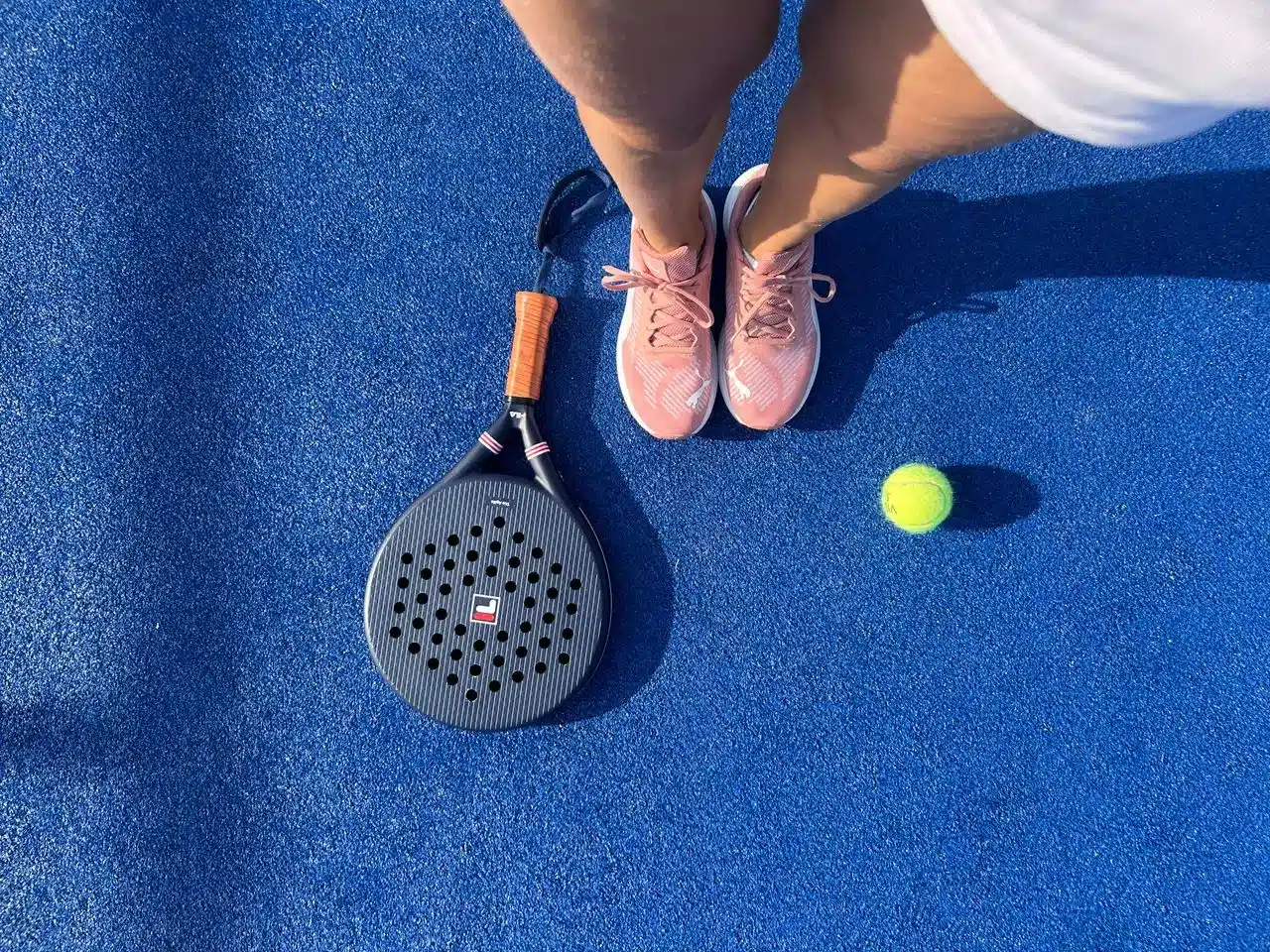
| Bat / racket | Solid, perforated, no strings | Solid paddle, no strings | Strung racket |
| Ball | Like a tennis ball, slightly less pressure | Plastic ball with holes | Felt-covered rubber ball |
| Serve | Underhand, after a bounce | Underhand | Usually overhead |
| Usually played as | Doubles | Doubles or singles | Singles or doubles |
| Scoring | Tennis-style (15, 30, 40) | Points to 11, win by 2 | 15, 30, 40 |
Court size
The biggest visible difference is the court. A pickleball court is less than a third of the area of a tennis doubles court, and a padel court sits in between, but is fully enclosed by walls.
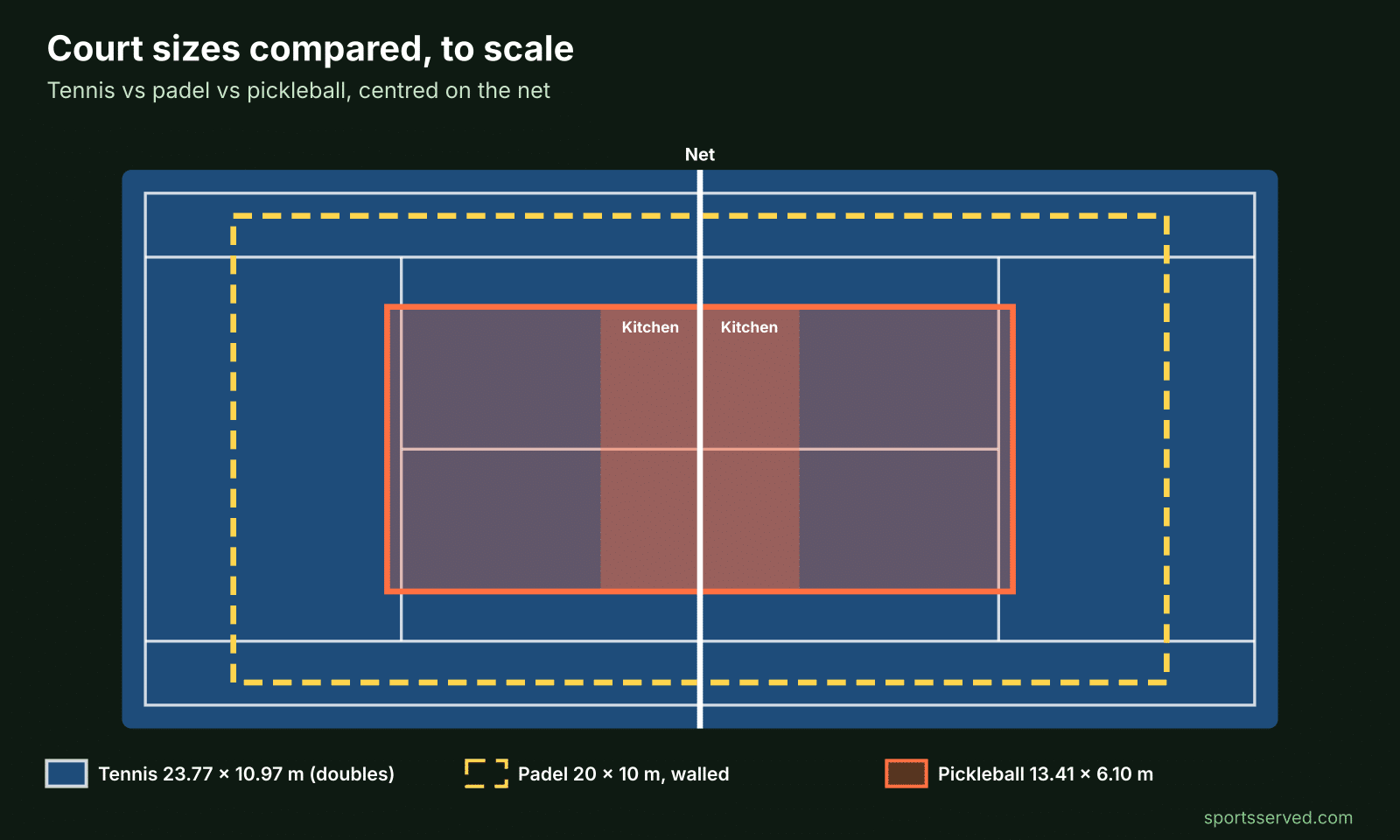
Smaller courts mean less ground to cover, one reason padel and pickleball are popular with beginners and older players.
Padel: tennis with walls
Padel is played in doubles on a 20 × 10 m court enclosed by glass and mesh walls. Its signature feature is the walls: after the ball bounces on the ground, players can let it rebound off the back and side walls and still play it, like squash.
Key rules:
- The serve is underhand. The server bounces the ball behind the service line and hits it at or below waist height, diagonally into the opposite service box.
- The ball must bounce on the ground first before it touches a wall on the opponents’ side. Hitting the wall directly is a fault.
- Scoring is the same as tennis: 15, 30, 40, game; sets to six games with a tiebreak at 6–6.
The new Star Point
The big change in padel is what happens at 40–40. Since 2026, the International Padel Federation’s rules have offered three options:
- Advantage: play continues until one pair wins two points in a row, as in tennis.
- Golden Point: one deciding point at the first deuce.
- Star Point (new in 2026): normal advantage is played up to twice; if the score comes back to deuce a third time, a single deciding point ends the game. The receiving pair chooses which side to receive on.
The Star Point is now used on the professional Premier Padel tour and the FIP Tour (FIP). The 2026 rules also added a penalty for dropping your racket during a point: the point goes to the opponents.
Pickleball: small court, big strategy
Pickleball is played on a badminton-sized court with solid paddles and a light plastic ball with holes, which moves slower than a tennis ball. It can be played as singles or doubles.
Key rules:
- The serve is underhand, hit below waist height, diagonally into the opposite service court.
- The two-bounce rule: the serve must bounce once, and the return must bounce once, before anyone may volley (hit the ball in the air).
- The kitchen: the non-volley zone is the 7-foot (2.13 m) area on each side of the net. You can’t volley while standing in it. This stops players from simply smashing everything at the net, and it’s why pickleball rallies are full of soft “dink” shots.
Pickleball scoring
Traditional pickleball uses side-out scoring: games go to 11 points, win by 2, and only the serving side can score. In doubles, the score is called as three numbers, such as “4–2–1”: the serving team’s score, the receiving team’s score, and whether it’s the first or second server.
Rally scoring, where a point is won on every rally regardless of who served, is an approved alternative format. Under USA Pickleball’s 2026 rules, the winning point in rally scoring can now be scored by either side, not just the serving team (USA Pickleball changes, via Selkirk).
Tennis: the original
Tennis has the largest court, the fastest ball and an overhead serve that can top 200 km/h at elite level. It rewards power, athleticism and years of technique, which is why it has the steepest learning curve of the three.
For how points, games and tiebreaks work, see our tennis scoring guide.
Which is easiest to start?
- Pickleball is usually the easiest: a small court, a slow ball and an underhand serve mean most beginners can rally in their first session.
- Padel is close behind. The walls keep the ball in play, the underhand serve is simple, and playing in pairs makes it social.
- Tennis takes the longest to learn, mainly because of the serve and the size of the court.
FAQ
Is padel the same as pickleball?
No. Padel is played on a larger, enclosed court with walls that are part of the game, using a ball similar to a tennis ball. Pickleball uses an open, smaller court, a plastic ball with holes and a “kitchen” zone near the net.
Can you play padel singles?
Official padel is played in doubles. Some clubs have narrower singles courts, but they are rare.
Is padel scoring the same as tennis?
Almost. It uses 15, 30, 40 and sets to six games, but at deuce the match may use advantage, a Golden Point or the new Star Point.
What is the kitchen in pickleball?
The non-volley zone: the 7-foot area on each side of the net where players may not hit the ball out of the air.
Why is it called pickleball?
The game was invented in 1965 on Bainbridge Island, near Seattle. One story says it was named after the family dog, Pickles; another says it comes from the “pickle boat” in rowing, a crew thrown together from leftover rowers, just as the game mixed bits of other sports.
Can you use a tennis racket for padel?
No. Padel uses a solid, stringless bat with holes, and a tennis racket isn’t allowed.