
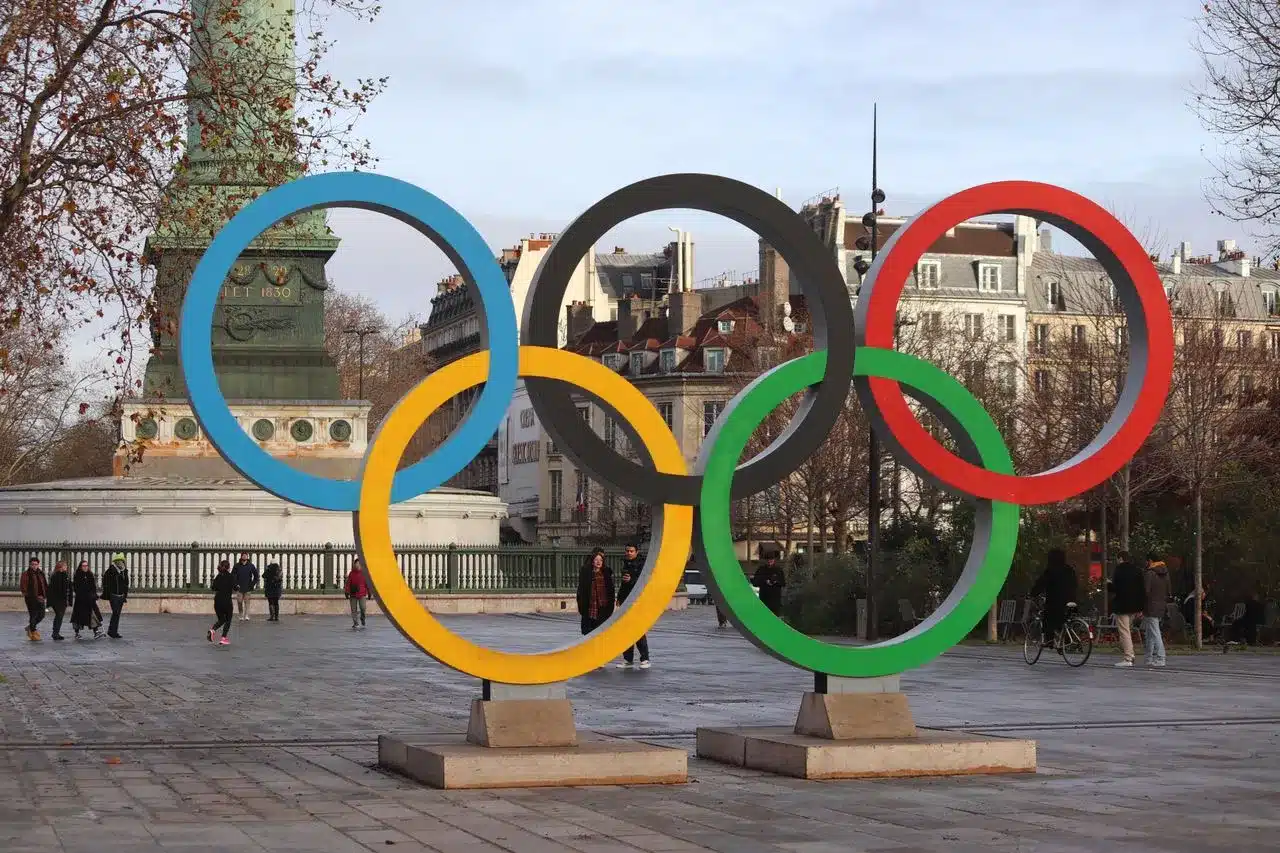
Five interlocking rings on a white background: it may be the most recognised symbol in the world, better known than many national flags. But what do the Olympic rings actually mean, and does each colour really stand for a continent?
Here’s the story of the rings, from a hand-drawn sketch in 1913 to the symbol of the modern Olympic movement.
Who designed the Olympic rings?
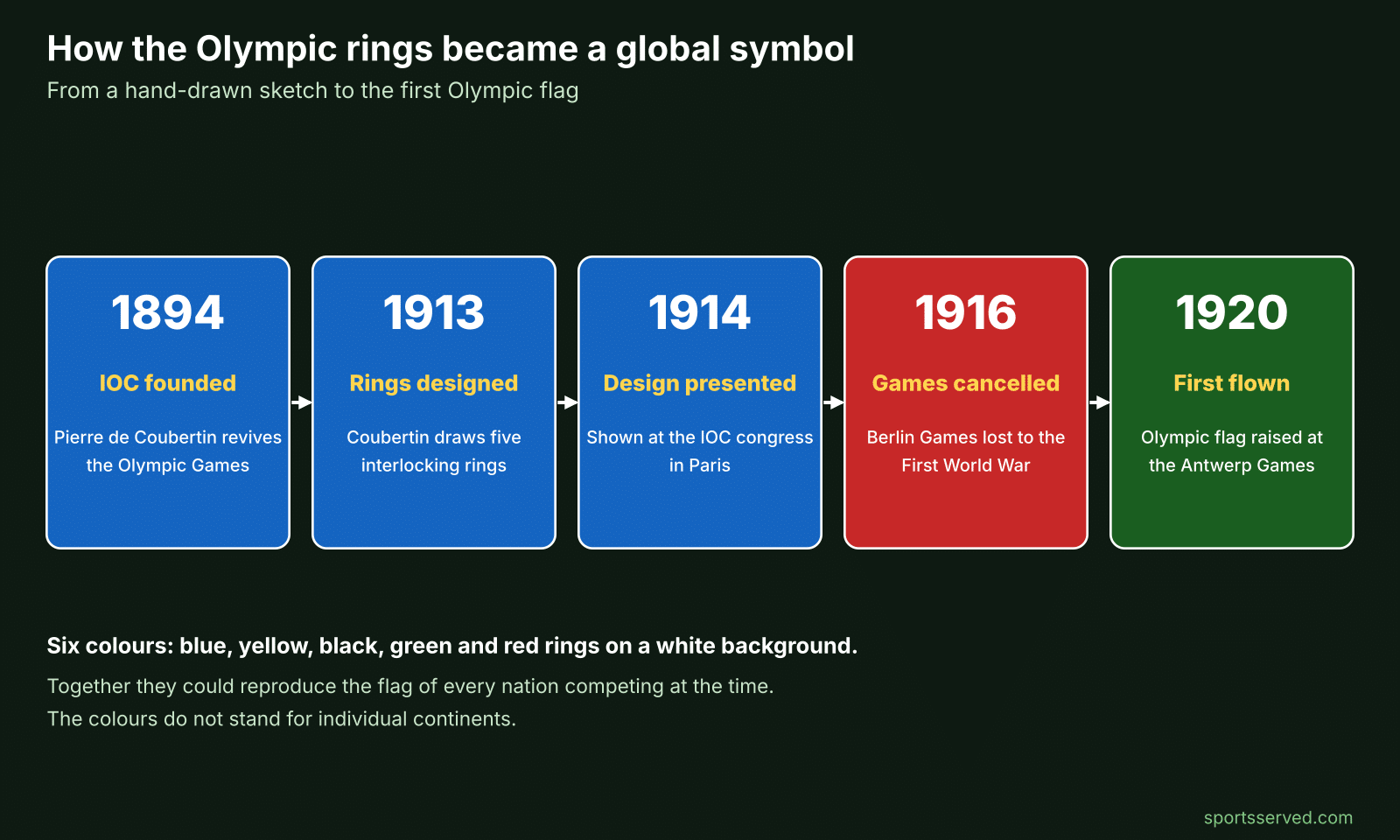
The rings were designed in 1913 by Pierre de Coubertin, the French educator who founded the modern Olympic Games. He drew them by hand at the top of a letter, and presented the design to the International Olympic Committee in 1914, at a congress in Paris celebrating the movement’s 20th anniversary.
The plan was to fly the new Olympic flag at the 1916 Games in Berlin, but those Games were cancelled because of the First World War. The flag finally flew in an Olympic stadium for the first time at the 1920 Games in Antwerp, Belgium.
What do the five rings mean?
According to Coubertin, the five rings represent the five parts of the world that took part in the Olympic movement at the time, interlinked to show the union of these continents and the meeting of athletes from around the world at the Games.
At the time, the five were usually counted as Africa, the Americas, Asia, Europe and Oceania.
Does each colour stand for a continent?
No, and this is the most common myth about the rings. It is often said that blue is Europe, yellow is Asia, black is Africa, green is Oceania and red is the Americas, but the IOC does not link any colour to a specific continent.
The real reason for the colours is different.
Why those six colours?
The rings are blue, yellow, black, green and red, on a white background. Coubertin chose these six colours because, between them, they could reproduce the flag of every nation competing at the time: the blue and yellow of Sweden, the blue and white of Greece, the tricolours of France, Britain, the US, Germany, Belgium, Italy and Hungary, the red and yellow of Spain, alongside newer nations such as Brazil, Australia, Japan and China.
In other words, the colours were chosen so that every country could see its own flag in the symbol.
How the rings are arranged
The rings are arranged in two rows: three on top (blue, black, red, from left to right) and two below (yellow and green). They interlock in a set order, and the IOC has strict rules about how the symbol can be drawn, coloured and used.
The rings are one of the most protected trademarks in the world. Only the IOC and its official partners may use them commercially, which is why you rarely see them on unofficial merchandise.
The Olympic flag
The Olympic flag shows the rings on a plain white background. At every Games, the flag is handed over at the closing ceremony from the mayor of the host city to the mayor of the next host city, a tradition known as the flag handover.
Other Olympic symbols
- The Olympic motto: “Citius, Altius, Fortius” (Faster, Higher, Stronger). In 2021, the IOC added the word “Communiter” (Together).
- The Olympic flame: lit in Olympia, Greece, using the sun’s rays and a parabolic mirror, then carried to the host city by a torch relay.
- The Olympic oath: taken by an athlete, a judge and a coach on behalf of all participants at the opening ceremony.
FAQ
What do the Olympic rings stand for?
The union of the five parts of the world that took part in the Olympic movement, and the meeting of athletes from around the globe at the Games.
Do the Olympic ring colours represent continents?
No. That’s a popular myth. The colours were chosen because, together with the white background, they could reproduce every competing nation’s flag.
Who created the Olympic rings?
Pierre de Coubertin, founder of the modern Olympic Games, designed them in 1913.
When were the Olympic rings first used at the Games?
The Olympic flag with the rings was first flown at the 1920 Games in Antwerp.
What are the five colours of the Olympic rings?
Blue, yellow, black, green and red, on a white background.