

Odds appear everywhere in sports coverage, from match previews to TV graphics. But the same chance can be written three different ways: 5/2, 3.50 or +250. They all mean exactly the same thing.
This guide explains how to read each format, how to convert between them, and how to turn odds into the probability the bookmaker is implying. It’s written to help you understand the numbers you see in sports coverage, not to encourage betting.
The three formats at a glance
| Format | Example | Mainly used in | What it shows |
|---|---|---|---|
| Fractional | 5/2 | UK and Ireland | Profit compared with your stake |
| Decimal | 3.50 | Europe, Australia, the Middle East, most online sites | Total return per 1 unit staked |
| American (moneyline) | +250 | United States | Profit on 100, or stake needed to win 100 |
Fractional odds (5/2)
Fractional odds tell you the profit you’d make compared with your stake.
- 5/2 (“five to two”) means you win 5 for every 2 you stake. A 10 stake returns 25 profit, plus your 10 back: 35 in total.
- Evens (1/1) means you win the same amount you stake.
- When the first number is smaller than the second, such as 1/2, the outcome is the favourite. You win 1 for every 2 staked.
Decimal odds (3.50)
Decimal odds show the total return for every 1 unit staked, including the stake itself. They are the easiest format to use.
- 3.50 means a 10 stake returns 35 in total (25 profit + the 10 stake).
- 2.00 is the same as evens.
- The lower the number, the more likely the bookmaker thinks the outcome is. Nothing can be lower than 1.00.
Quick conversion: decimal = fractional + 1. So 5/2 = 2.5 + 1 = 3.50.
American odds (+250 / −200)
American odds use 100 as their reference point and come with a plus or minus sign.
- Plus (+) numbers are underdogs. They show the profit on a 100 stake. +250 means a 100 stake wins 250 profit.
- Minus (−) numbers are favourites. They show how much you need to stake to win 100. −200 means you must stake 200 to win 100 profit.
Implied probability: what the odds are really saying
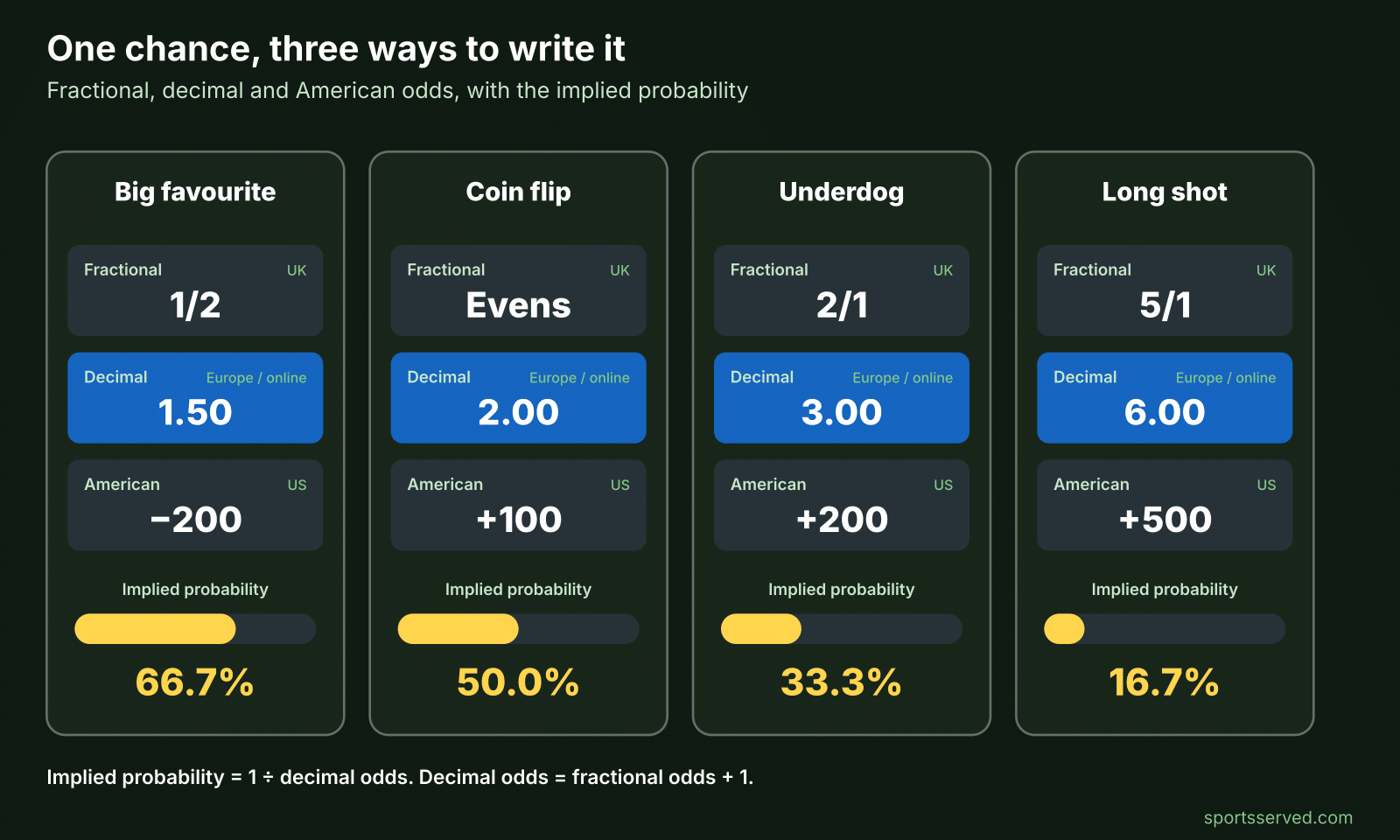
Every price hides a probability: the bookmaker’s estimate of how likely the outcome is. You can work it out from decimal odds with one simple calculation:
Implied probability = 1 ÷ decimal odds
- 2.00 → 1 ÷ 2 = 50%
- 3.50 → 1 ÷ 3.5 = 28.6%
- 1.50 → 1 ÷ 1.5 = 66.7%
Why the probabilities add up to more than 100%
Add up the implied probabilities for every outcome of a match and you’ll get more than 100%, often 104–108%. The extra is the bookmaker’s built-in margin, often called the overround or “vig”. It means the odds on offer are always slightly shorter than the true chances would justify, which is how bookmakers make money over time.
Example: a match priced at 2.10 home, 3.40 draw and 3.60 away implies 47.6% + 29.4% + 27.8% = 104.8%. The 4.8% is the margin.
Conversion table
| Fractional | Decimal | American | Implied probability |
|---|---|---|---|
| 1/4 | 1.25 | −400 | 80.0% |
| 1/2 | 1.50 | −200 | 66.7% |
| 4/5 | 1.80 | −125 | 55.6% |
| Evens (1/1) | 2.00 | +100 | 50.0% |
| 6/4 | 2.50 | +150 | 40.0% |
| 2/1 | 3.00 | +200 | 33.3% |
| 5/2 | 3.50 | +250 | 28.6% |
| 3/1 | 4.00 | +300 | 25.0% |
| 5/1 | 6.00 | +500 | 16.7% |
| 10/1 | 11.00 | +1000 | 9.1% |
A note on gambling
Sports betting is illegal in some countries and tightly regulated in others. If you do bet where it’s legal, treat it as paid entertainment, set a limit you can afford to lose, and never chase losses. If gambling stops being fun, organisations such as GamCare (UK) and the National Council on Problem Gambling (US) offer free, confidential help.
FAQ
What does 5/1 mean in betting?
It means you win 5 for every 1 you stake. A 10 stake returns 50 profit plus your 10 back.
What do negative odds mean?
In American odds, a minus sign marks the favourite and shows how much you must stake to win 100. −150 means staking 150 to win 100.
How do I convert fractional odds to decimal?
Divide the first number by the second and add 1. For example, 7/4 = 1.75 + 1 = 2.75.
What does “odds-on” mean?
That the outcome is considered more likely than not: odds shorter than evens, such as 1/2 or 1.50.
Which odds format is easiest for beginners?
Decimal odds, because the number already includes your stake: multiply your stake by the odds to see the total return.
What does a 50% implied probability mean?
That the odds (2.00, evens or +100) suggest the outcome has a one-in-two chance, before the bookmaker’s margin is taken into account.