
Sport would be far less fun if the favourite always won. The moments we remember most are the ones nobody saw coming: the part-timers who beat the professionals, the 42-1 outsider who knocked out the champion, the team given no chance that went on to lift the trophy.
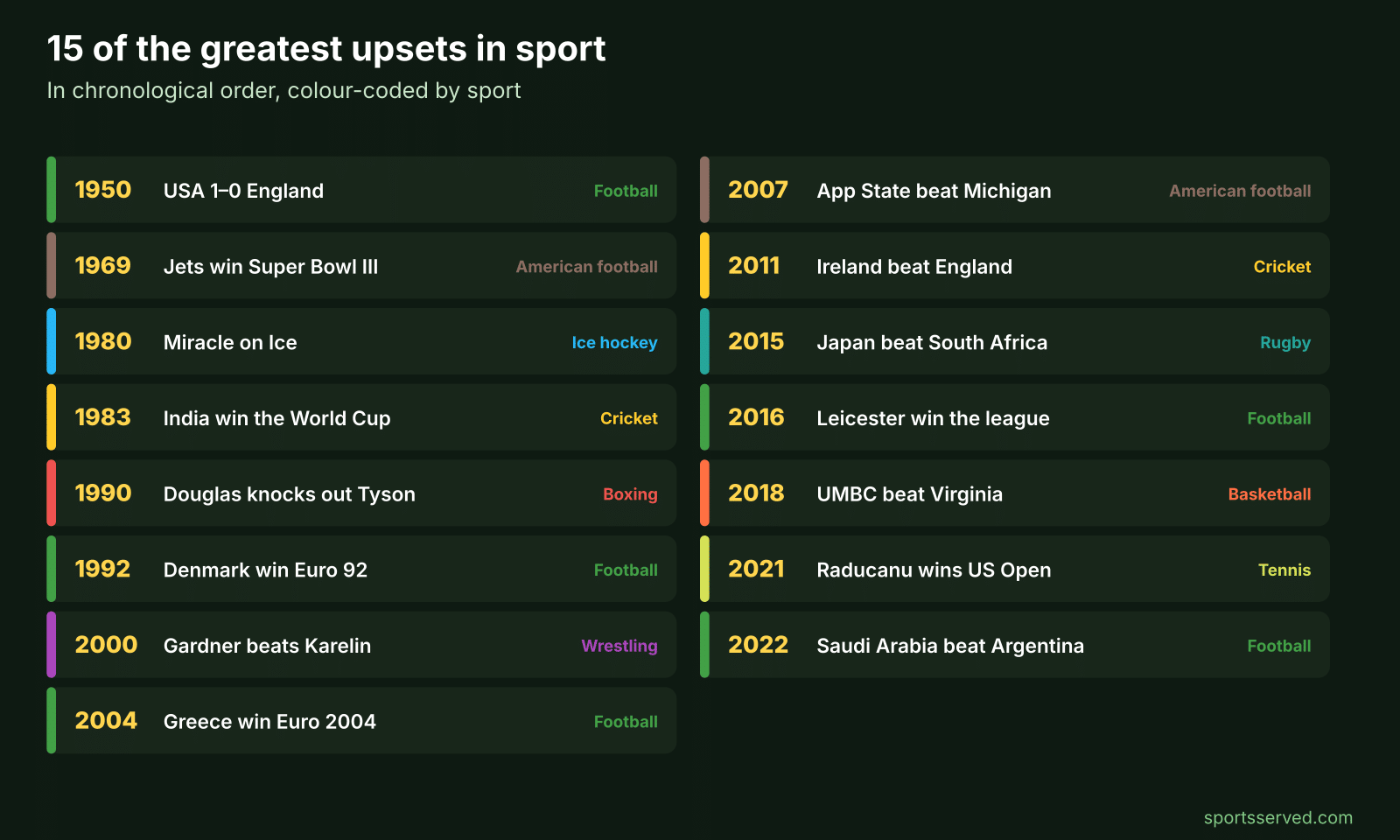
Here are 15 of the greatest upsets in sports history, in chronological order.
1. USA 1–0 England (1950 World Cup)
England arrived at their first World Cup as one of the favourites. The United States team was made up largely of part-timers. In Belo Horizonte, Brazil, a header from Joe Gaetjens gave the Americans a 1–0 win, a result so unexpected that some newspapers back in England reportedly assumed it was a misprint.
2. New York Jets 16–7 Baltimore Colts (Super Bowl III, 1969)
The Jets represented the younger AFL, widely considered weaker than the NFL. Quarterback Joe Namath publicly guaranteed victory days before the game, and then delivered it. The result helped prove the two leagues could compete as equals ahead of their merger.
3. The “Miracle on Ice” (1980 Winter Olympics)
At Lake Placid, a United States ice hockey team of college players beat the Soviet Union, the dominant team in the world, 4–3. Commentator Al Michaels’s call, “Do you believe in miracles? Yes!”, became one of the most famous lines in sports broadcasting. The Americans then beat Finland to win gold.
4. India win the Cricket World Cup (1983)
India had won just one World Cup match in the two previous tournaments. In the final at Lord’s they faced the mighty West Indies, champions in 1975 and 1979, and were bowled out for just 183. Then their bowlers dismissed the West Indies for 140, and Kapil Dev’s team won by 43 runs. The victory transformed cricket in India.
5. Buster Douglas knocks out Mike Tyson (1990)
Mike Tyson was the undefeated, undisputed heavyweight champion of the world. James “Buster” Douglas was a 42-1 outsider. In Tokyo, Douglas survived a knockdown in the eighth round and knocked Tyson out in the tenth, one of the biggest shocks in boxing history.
6. Denmark win Euro 1992
Denmark hadn’t even qualified. They were called up around ten days before the tournament, when Yugoslavia were excluded because of the war in the Balkans. Many of their players were reportedly on holiday. They went on to beat the Netherlands in the semi-final and Germany 2–0 in the final.
7. Rulon Gardner beats Aleksandr Karelin (2000 Olympics)
Russian wrestler Aleksandr Karelin was a three-time Olympic champion who had gone around 13 years unbeaten in international competition. In the Greco-Roman final in Sydney, American farm boy Rulon Gardner beat him 1–0.
8. Greece win Euro 2004
Greece had never won a match at a major tournament before 2004. With a disciplined defensive team, they beat hosts Portugal in the opening game, then knocked out France and the Czech Republic, and beat Portugal again, 1–0, in the final.
9. Appalachian State 34–32 Michigan (2007)
Michigan, ranked fifth in the country, opened their college football season at home against Appalachian State from the lower FCS division. The visitors blocked a last-second field goal to complete one of the biggest shocks in college sports.
10. Ireland beat England (2011 Cricket World Cup)
Chasing 328 in Bangalore, Ireland were 111 for 5. Then Kevin O’Brien smashed a century from just 50 balls, then the fastest in World Cup history, to win the match with five balls to spare.
11. Japan 34–32 South Africa (2015 Rugby World Cup)
South Africa were two-time world champions. Japan had won one Rugby World Cup match in 24 years. In Brighton, with the last move of the game, Japan turned down a kick at goal that would have earned a draw, went for the try, and scored it. The match is now known as the “Brighton Miracle”.
12. Leicester City win the Premier League (2015/16)
A year earlier, Leicester had narrowly avoided relegation. Bookmakers made them 5000-1 to win the league, odds that are still quoted as a byword for the impossible. With a compact 4-4-2 and devastating counter-attacks, they won the title by ten points.
13. UMBC 74–54 Virginia (2018 NCAA Tournament)
In the men’s college basketball tournament, no 16th seed had ever beaten a number 1 seed in 135 attempts. Then the University of Maryland, Baltimore County didn’t just beat top-seeded Virginia; they won by 20 points.
14. Emma Raducanu wins the US Open (2021)
Ranked 150th in the world, 18-year-old Emma Raducanu had to come through qualifying just to reach the main draw. She won ten matches in a row without dropping a single set to become the first qualifier in history to win a Grand Slam singles title.
15. Saudi Arabia 2–1 Argentina (2022 World Cup)
Argentina arrived in Qatar on a 36-match unbeaten run, led by Lionel Messi. In their opening game, Saudi Arabia came from behind with two goals in five minutes to win 2–1. Argentina recovered to win the tournament, which only makes the result more remarkable.
What makes a great upset?
The best upsets usually combine three things: a huge gap in expectations, a big stage, and a result that changes something, whether a sport’s popularity in a country, the reputation of a league, or simply what fans believe is possible.
FAQ
What is the biggest upset in sports history?
There’s no official answer, but the Miracle on Ice, Buster Douglas vs Mike Tyson and Leicester City’s 5000-1 Premier League title are the most commonly cited.
What were Leicester City’s odds to win the Premier League?
5000-1 at the start of the 2015/16 season.
What odds was Buster Douglas against Mike Tyson?
He was a 42-1 underdog.
What is the “Miracle on Ice”?
The United States’ 4–3 win over the Soviet Union in ice hockey at the 1980 Winter Olympics in Lake Placid.
Has a 16 seed ever beaten a 1 seed in March Madness?
Yes. UMBC beat Virginia in 2018, the first time it happened in the men’s tournament.