Football has a language of its own. Commentators talk about “false nines”, “low blocks” and “second balls”, and pundits assume you know what a “brace” or a “nutmeg” is. This glossary explains 100 of the most common football terms in plain English, from A to Z.
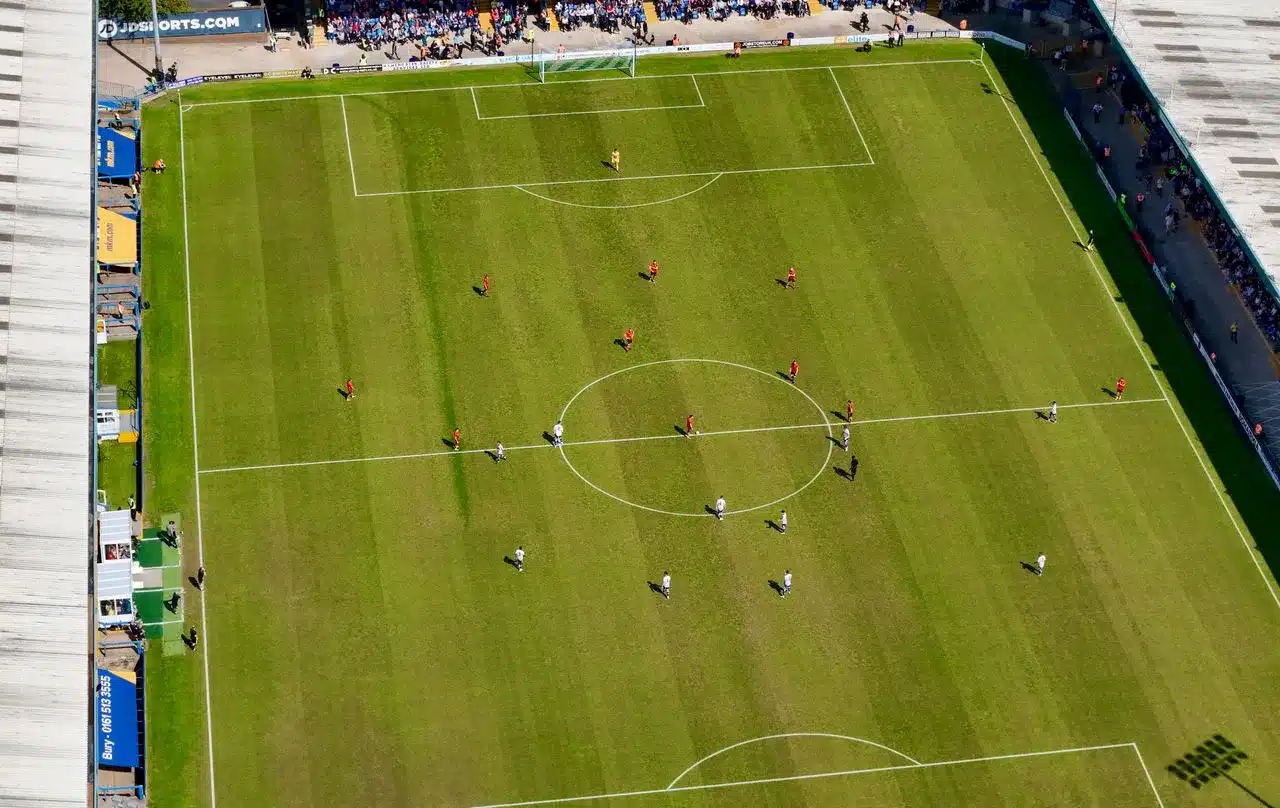
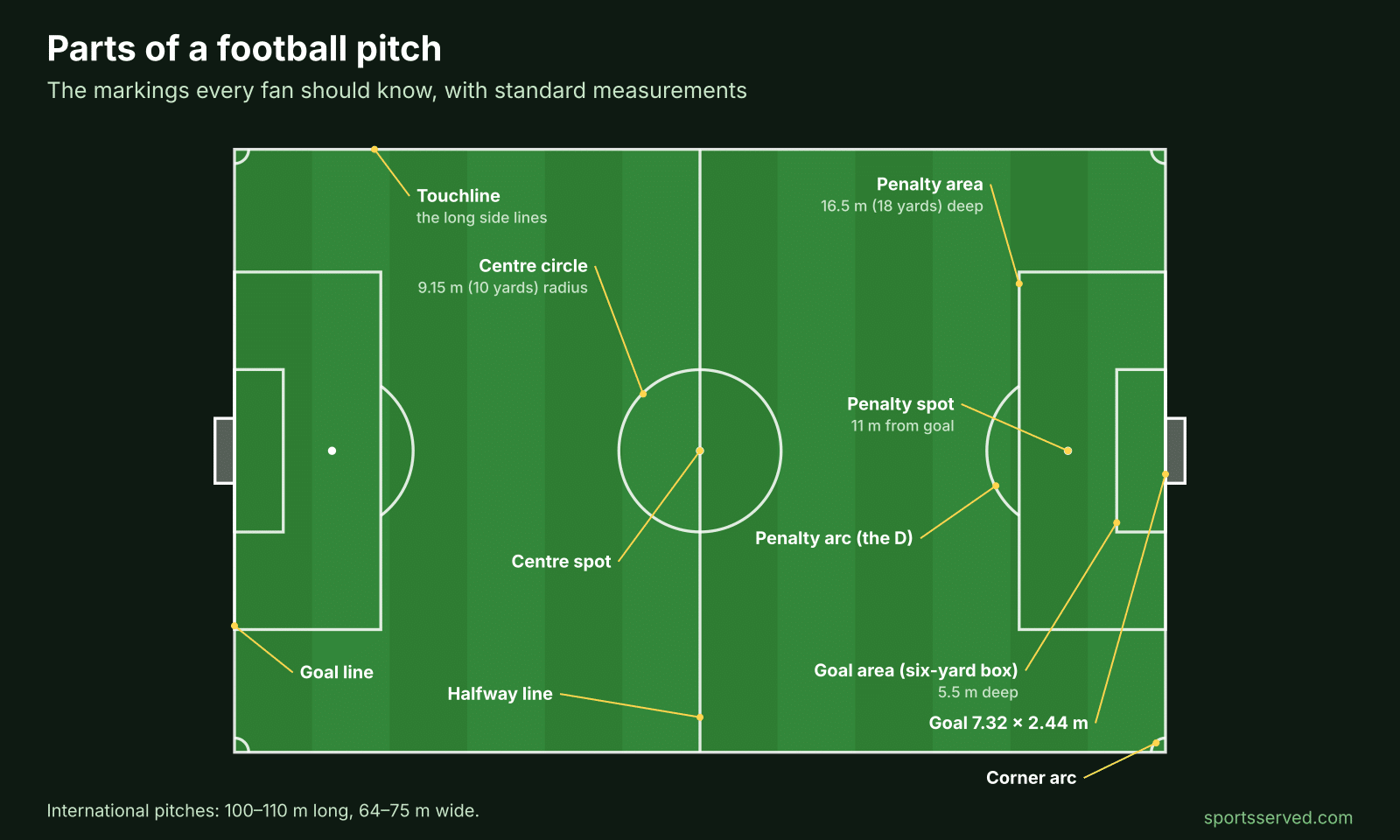
Start with the labelled pitch below, then use the alphabetical list as a reference whenever a word on TV leaves you puzzled.
A–B
- Added time (stoppage time): minutes added at the end of each half to make up for time lost to injuries, substitutions, VAR checks and time-wasting.
- Advantage: when the referee lets play continue after a foul because stopping it would help the team that committed the foul.
- Aggregate: the combined score over two legs of a tie.
- Assist: the final pass or touch that sets up a goal.
- Away goals rule: an old tiebreaker in two-legged ties where goals scored away counted extra. UEFA scrapped it in 2021.
- Back four: a defence of four players, usually two centre-backs and two full-backs.
- Ballon d’Or: the most famous individual award in football, given each year to the best player in the world.
- Bicycle kick (overhead kick): an acrobatic shot where a player kicks the ball backwards over their own head.
- Booking: a yellow card. The referee “books” a player by noting their name.
- Box: short for the penalty area.
- Box-to-box midfielder: a midfielder who covers the whole pitch, defending in their own box and attacking the opponents’.
- Brace: two goals by the same player in one match.
- Build-up play: how a team moves the ball from defence into attack.
C–D
- Cap: an appearance for a national team. A player with 50 caps has played 50 international matches.
- Captain’s armband: the band worn by the team captain.
- Catenaccio: a famously defensive Italian system built around a spare defender (the “libero”).
- Centre-back: a central defender.
- Chip: a shot or pass lifted gently over an opponent, often the goalkeeper.
- Clean sheet: a match in which a team (or goalkeeper) concedes no goals.
- Corner kick: a restart taken from the corner arc when the defending team last touched the ball before it crossed their own goal line.
- Counter-attack: a fast attack launched straight after winning the ball, before the opponents can reorganise.
- Cross: a pass from a wide position into the penalty area.
- Cup tie: a knockout match in a cup competition.
- Dead ball: any set piece taken while the ball is stationary, such as a free kick or corner.
- Derby: a match between two local rivals.
- Direct free kick: a free kick from which a goal can be scored straight away.
- Dive (simulation): pretending to be fouled to win a free kick or penalty. It is punished with a yellow card.
- Dribble: running with the ball under close control past opponents.
- Dummy: pretending to play the ball and letting it run past, to fool an opponent.
E–G
- Equaliser: a goal that makes the score level.
- Extra time: two 15-minute periods played in knockout matches that are level after 90 minutes.
- False 9: a centre-forward who drops deep into midfield instead of staying up front, pulling defenders out of position.
- Final third: the attacking third of the pitch, nearest the opponents’ goal.
- First touch: how well a player controls the ball when receiving it.
- Formation: the shape a team lines up in, written as numbers from defence to attack, such as 4-3-3.
- Free transfer: when a player moves to a new club at the end of their contract, with no fee paid.
- Full-back: a defender on either side of the centre-backs in a back four.
- Golden boot: the award for the top scorer in a league or tournament.
- Goal difference: goals scored minus goals conceded. It usually separates teams level on points.
- Goal kick: a restart taken from the six-yard box when the attacking team last touched the ball before it crossed the goal line.
- Goal-line technology: cameras or sensors that tell the referee instantly whether the whole ball crossed the goal line.
H–L
- Handball: deliberately handling the ball, or making your body unnaturally bigger with your arm. Penalised with a free kick or penalty.
- Hat-trick: three goals by the same player in one match.
- Header: playing the ball with the head.
- High line: when a defence pushes up far from its own goal, to squeeze the space and catch attackers offside.
- Holding midfielder (defensive midfielder): a midfielder who sits in front of the defence to protect it.
- Home and away: two-legged ties, or a league in which every team plays every other team at both grounds.
- Indirect free kick: a free kick that must touch another player before a goal can be scored.
- Injury time: another name for added time.
- Interception: cutting out an opponent’s pass.
- Kick-off: the restart from the centre spot at the start of each half and after every goal.
- Kit: a team’s playing outfit: shirt, shorts and socks.
- Last man: the final defender between an attacker and the goalkeeper. A foul by the last man to stop a clear goalscoring chance can be a red card.
- Left-back / right-back: the full-backs on the left and right of defence.
- Libero (sweeper): a free defender who plays behind the rest of the back line.
- Loan: when a player temporarily joins another club, usually for a season.
- Long ball: a long pass forward, usually aimed at a tall striker.
- Low block: when a team defends deep near its own penalty area, with little space between the lines.
M–O
- Man-marking: when each defender is responsible for one particular opponent.
- Man of the Match (Player of the Match): the award for the best player in a game.
- Nutmeg: passing the ball between an opponent’s legs.
- Number 10: the creative attacking midfielder who plays behind the striker.
- Offside: being nearer the opponents’ goal line than the ball and the second-last opponent when a teammate passes, and then becoming involved in play.
- One-two (wall pass): a quick pass to a teammate who returns it first time as you run past a defender.
- Own goal: a goal a player accidentally scores into their own net.
- Overlap: when a full-back runs past a winger on the outside to create a two-against-one.
P–R
- Panenka: a softly chipped penalty down the middle, named after Czech player Antonín Panenka.
- Parking the bus: defending with almost the whole team behind the ball.
- Penalty (spot kick): a free shot from the penalty spot, given for a foul by the defending team inside its own penalty area.
- Penalty shoot-out: five penalties per team (then sudden death) to settle a knockout match that is level after extra time.
- Playmaker: the player who creates chances and controls the team’s passing.
- Possession: the percentage of time a team has the ball.
- Press (pressing): closing down opponents quickly to win the ball back. A high press does it near the opponents’ goal.
- Promotion and relegation: the best teams in a division move up, the worst move down.
- Red card: a sending-off. The player must leave the pitch and can’t be replaced.
- Relegation zone: the bottom places in a league table that lead to relegation.
S–T
- Save: when the goalkeeper stops a shot.
- Second ball: the loose ball after a header or a challenge. Teams fight to win it.
- Set piece: a planned move from a dead ball: corners, free kicks and throw-ins.
- Six-yard box (goal area): the small box in front of the goal.
- Sliding tackle: a tackle made by sliding along the ground to reach the ball.
- Squad rotation: changing the starting line-up between matches to rest players.
- Stoppage time: another name for added time.
- Striker: the main goalscorer, usually the most forward player.
- Substitute: a player who comes on to replace a teammate during the match.
- Tackle: taking the ball from an opponent with the feet.
- Target man: a tall, strong striker the team aims long balls at.
- Through ball: a pass played into space behind the defence for a teammate to run on to.
- Throw-in: the restart when the ball crosses the touchline, taken with both hands from behind the head.
- Tiki-taka: a style built on short, quick passing and constant movement, made famous by Barcelona and Spain.
- Touchline: the long side lines of the pitch.
- Transfer window: the periods when clubs are allowed to sign players from other clubs.
U–Z
- Unbeaten run: a series of matches without a defeat.
- VAR: the video assistant referee, who reviews goals, penalties, red cards and cases of mistaken identity.
- Volley: kicking the ball before it touches the ground.
- Wall: the line of defenders standing 9.15 m (10 yards) from a free kick to block the shot.
- Wing-back: a wide player in a back-three system who covers the whole flank.
- Winger: an attacking player who plays near the touchline.
- xG (expected goals): a statistic estimating how likely a shot is to become a goal, based on thousands of similar shots.
- Yellow card: a caution. Two yellow cards in one match mean a red card.
- Zonal marking: when defenders guard an area of the pitch rather than a particular opponent, common at corners.
FAQ
What is the difference between a brace and a hat-trick?
A brace is two goals by one player in a match; a hat-trick is three.
What does “clean sheet” mean?
That a team didn’t concede a goal in the match. It is often credited to the goalkeeper.
What is the difference between soccer and football?
They are the same sport. “Soccer” is used mainly in the US, Canada and Australia; most of the world calls it football.
What is xG in football?
Expected goals: a measure of the quality of a team’s chances, based on how often similar shots are scored.
What is a nutmeg?
Playing the ball through an opponent’s legs and collecting it on the other side.