
VAR has changed football more than any rule in decades. It has also caused more confusion than almost anything else: why was that goal checked for three minutes, why didn’t VAR give a penalty, and who actually makes the decision?
This guide explains what the video assistant referee is, exactly what it can and can’t review, and how a VAR decision is made step by step. It reflects the Laws of the Game for 2026/27.
What is VAR?
VAR stands for video assistant referee. It is a team of match officials who sit in a video room, often far from the stadium, and watch the game on multiple camera angles. The lead official is the VAR; they are helped by one or more assistants (AVARs).
The key principle is “minimum interference, maximum benefit”. VAR is not there to re-referee the match. It only steps in for:
- a clear and obvious error by the referee, or
- a serious missed incident the referee didn’t see.
And it always stays the on-field referee’s decision. VAR advises; the referee decides.
What VAR can review
VAR can only get involved in a short list of match-changing situations:
- Goals, and any offence in the build-up (offside, a foul, handball, the ball going out of play).
- Penalties: whether one should be given, or was wrongly given.
- Direct red cards (not second yellow cards, apart from the exception below).
- Mistaken identity: when the referee cautions or sends off the wrong player.
From the 2026/27 season, IFAB widened that list. VAR may now also review:
- a red card that results from a clearly wrong second yellow card,
- a yellow or red card shown to the wrong player when the offence was actually committed by a player of either team, and
- in competitions that choose to use it, a wrongly awarded corner kick, if the decision can be changed immediately.
What VAR cannot do is just as important. It can’t review ordinary fouls in midfield, normal yellow cards, throw-ins or free kicks. And it can’t step in if the referee missed a second yellow card altogether.
How a VAR decision is made
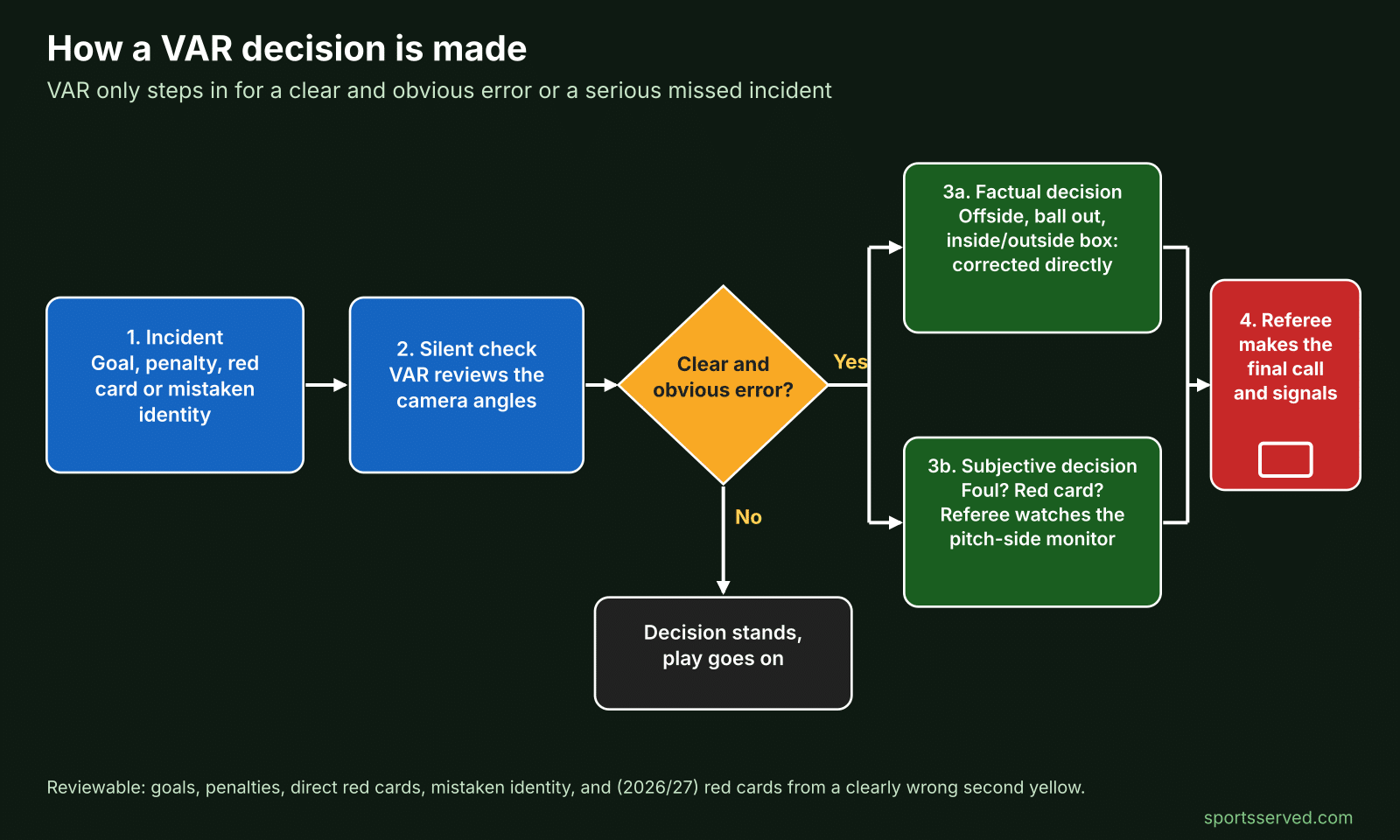
Every goal, penalty incident and red-card incident is checked, but most checks happen silently while play continues. Here’s what happens:
- The check. VAR reviews the incident in the background. If there’s no clear error, nothing happens and the game goes on. Most checks end here.
- The recommendation. If VAR sees a clear error or a serious missed incident, they tell the referee through their headset and recommend a review.
- The decision. What happens next depends on the type of decision:
- Factual decisions (offside position, whether the ball crossed a line, whether a foul was inside or outside the box) can be corrected directly on VAR’s information.
- Subjective decisions (was it a foul? was it serious enough for a red card?) usually go to an on-field review, where the referee watches the replay on a pitch-side monitor.
- The signal. The referee draws a rectangle in the air (the TV-screen signal) and announces the final decision. In some competitions the referee now explains it to the crowd over the stadium microphone.
Why do VAR checks take so long?
A check has to look at several camera angles and, for offside, find the exact frame when the ball was played. The longest checks are usually offside calls that come down to centimetres, or incidents where no camera shows the contact clearly.
Semi-automated offside technology (SAOT) has sped this up in competitions that use it. Tracking cameras follow players’ limbs and the ball, and the system flags offside to the VAR automatically. The result is shown to fans as a 3D animation. For how the offside line itself works, see our offside rule guide.
A short history of VAR
VAR was trialled from 2016 and written into the Laws of the Game by IFAB in 2018. The 2018 World Cup in Russia was the first World Cup to use it. Since then it has spread to most major leagues, and its scope has been adjusted almost every year, most recently with the 2026/27 changes above.
FAQ
Who makes the final decision, VAR or the referee?
The on-field referee. VAR only advises; the referee can accept or reject the recommendation after an on-field review.
Can VAR give a yellow card?
Generally no. Ordinary yellow cards are outside VAR’s scope. The exceptions are mistaken identity and, from 2026/27, a red card that came from a clearly wrong second yellow.
Can a manager ask for a VAR review?
Not under the standard VAR system. Only the VAR team or the referee can start a review. FIFA has trialled a lighter system called Football Video Support, where coaches get a limited number of review requests, in competitions that don’t use full VAR.
Does VAR check every goal?
Yes. Every goal is checked in the background, but most checks are completed silently without stopping the restart.
What does “clear and obvious error” mean?
That almost everyone watching the replay would agree the decision was wrong. If it’s a close or debatable call, the referee’s original decision stands.
Where does the VAR sit?
In a video operation room, which can be at the stadium or at a central hub serving several matches.