
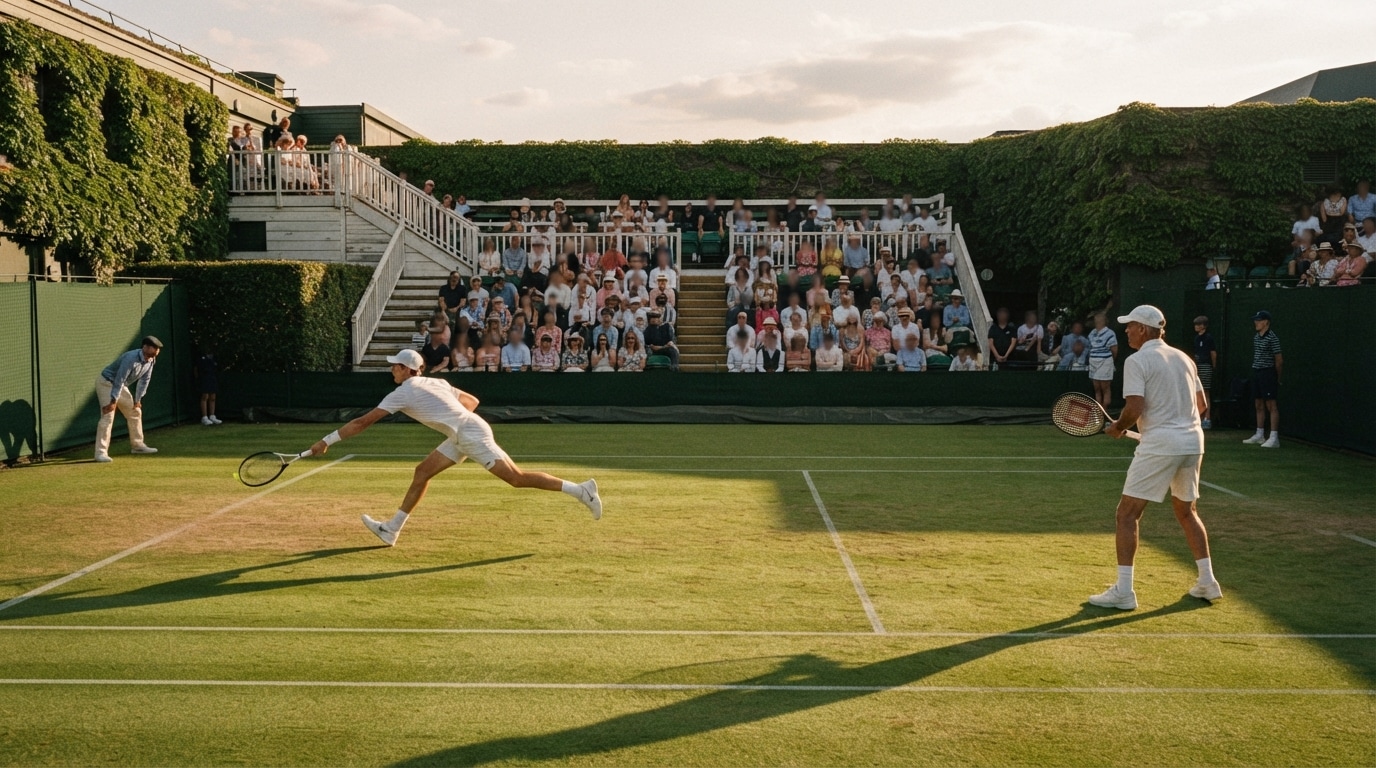
Rafael Nadal’s third-round win over Andre Agassi at Wimbledon on July 1, 2006, has grown into a landmark moment, signposting a handover between generations and hinting at what the Spaniard would later achieve on grass.
Nadal, then 20 and ranked world No. 2 after securing a second straight French Open title, beat the 36-year-old American 7-6(5), 6-2, 6-4 in two hours and 14 minutes on Centre Court. The scoreline does not fully convey the weight of the occasion: Agassi had confirmed days earlier that he would retire after the US Open, making this his final appearance at the All England Club, the stage of his first Grand Slam triumph in 1992.
A Clash of Generations
Agassi arrived in 2006 carrying the history of a career Grand Slam, a former No. 1 ranking, a deep mid-career slump, and a celebrated resurgence. He opened his last Wimbledon by rallying from a set down to defeat Boris Pashanski and then advanced past Andreas Seppi in straight sets. Nadal’s start was shakier. He swept past Alex Bogdanovic in the first round but survived a major scare against Robert Kendrick, coming back from two sets down to win in five and exposing how much grass still tested his game.
Their Centre Court meeting began evenly. Agassi struck cleanly from the baseline and used the surface speed to keep points short, pushing the first set to a tiebreak. Nadal edged it, and the match tilted. Freer after the lead, the Spaniard tightened his length on return, passed with authority, and turned exchanges into physical tests that demanded repeated precision. He pulled away 6-2 in the second set. Agassi fought hard to extend his farewell in the third, but Nadal closed it out 6-4.
The ovation for Agassi underscored the moment. He had come full circle at a venue that helped define him, from a brash newcomer in 1992 to a model of professionalism and longevity. Nadal, still learning grass-court nuances and far from the full breadth of his future résumé, showed a profile that would become familiar: relentless focus, point-by-point discipline, and an ability to force opponents into one more shot.
The victory became a springboard. Nadal beat Irakli Labadze in the last 16, overpowered Jarkko Nieminen in the quarter-finals, and defeated Australian Open finalist Marcos Baghdatis in the semi-finals to reach his first Wimbledon final. There he faced Roger Federer, who was chasing a fourth straight title, and fell 6-0, 7-6(5), 6-7(2), 6-3 after pushing the champion harder than many expected. The matchup set the tone for the next two years: Federer won again in the 2007 final, and Nadal captured the 2008 title in a classic decided 9-7 in the fifth set.
Viewed 20 years later, the 2006 third-round match reads as a moment of transition. Agassi departed Wimbledon with respect and without a final flourish, while Nadal moved forward toward his first final on the grass and, in time, a haul that would include Wimbledon titles, Olympic gold, and 22 major trophies. One career was closing; another was discovering just how far it could go.