

Tennis has one of the strangest scoring systems in sport. Points go 15, 30, 40. Zero is called “love”. And sometimes a game seems to go on forever. Once you see how the pieces fit together, though, it’s surprisingly logical.
This guide explains tennis scoring from the smallest unit to the biggest, then looks at where those odd numbers came from.
The four building blocks
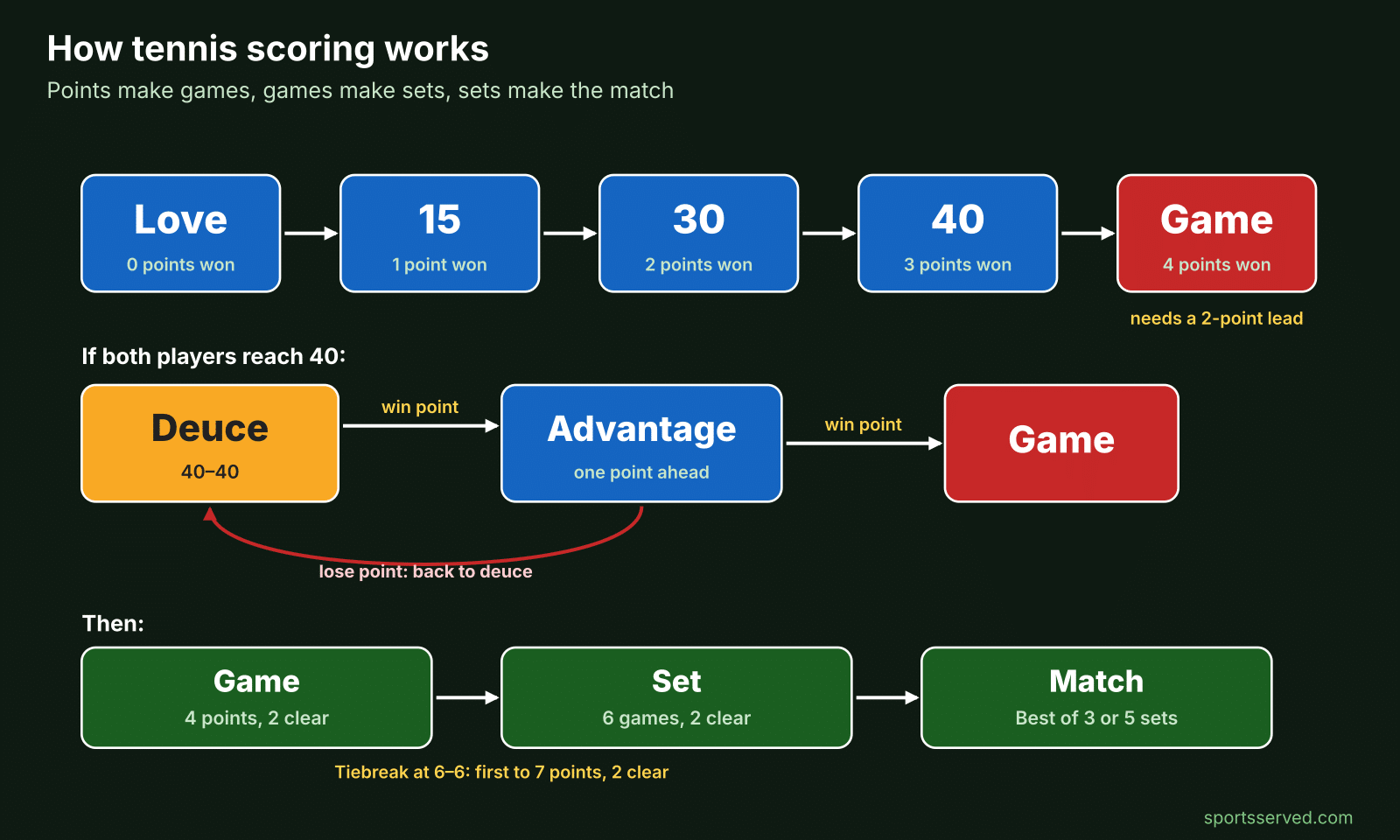
Tennis scoring works in layers:
- Points make a game.
- Games make a set.
- Sets make a match.
Win enough of one to win the next. That’s the whole structure.
Points: love, 15, 30, 40
Within a game, points are counted like this:
| Points won | Called |
|---|---|
| 0 | Love |
| 1 | 15 |
| 2 | 30 |
| 3 | 40 |
| 4 | Game (if at least 2 points ahead) |
The server’s score is always called first. So “30–love” means the server has won two points and the receiver none; “15–40” means the receiver is one point from winning the game.
Deuce and advantage
If both players reach 40, the score is deuce. From deuce, a player must win two points in a row to win the game:
- Win the next point and you have advantage.
- Win the point after that and you win the game.
- Lose it and the score goes back to deuce.
This is why some games last ten minutes or more.
Some formats skip it. In no-ad scoring, used in professional doubles, the point at deuce is decisive: whoever wins it wins the game.
Games and sets
A set is won by the first player to win six games, with a lead of at least two. So 6–4 wins a set, but 6–5 doesn’t; play continues to 7–5.
If the set reaches 6–6, a tiebreak decides it.
How a tiebreak works
In a tiebreak, points are counted normally: 1, 2, 3 and so on.
- The first player to 7 points, at least two ahead, wins the tiebreak and the set 7–6.
- The serve rotates: one player serves the first point, then each player serves two points in turn.
- Players change ends after every six points.
In the deciding set at all four Grand Slams, the tiebreak at 6–6 goes to 10 points instead of 7 (still two clear). Before this was standardised in 2022, each Slam had its own rule, and some deciding sets went on for hours.
Matches
Most matches are best of three sets: the first to win two sets wins. At the Grand Slams, men play best of five: the first to three sets.
Serve alternates every game throughout the match, and players change ends after every odd-numbered game (after games 1, 3, 5 and so on) in each set.
Why 15, 30, 40? The history
Nobody knows for certain, but there are two popular theories.
The clock face. In medieval France, where the ancestor of tennis (jeu de paume) was played, a clock face may have been used to keep score, moving the hand to 15, 30 and 45 minutes. The 45 was later shortened to 40, perhaps to make room for deuce: from 40, a player could move to 50 (advantage) and 60 (game) without running out of clock.
The court distance. Another theory says the server moved 15 feet forward each time they won a point, until the third step had to be shorter (10 feet) to keep them from reaching the net.
Why is zero called “love”?
Again, there are only theories. The most popular is that it comes from the French l’oeuf, “the egg”, because an egg looks like a zero. Another is that a player with no points is still playing “for love” of the game rather than to win.
FAQ
What does deuce mean in tennis?
When both players have 40 points in a game. A player must then win two points in a row to win the game.
How many games are in a set?
A set is won by the first player to six games with a two-game lead, or by winning a tiebreak at 6–6. So a set can have between 6 and 13 games.
Who serves first in a tiebreak?
The player whose turn it is to serve. They serve one point, then the players alternate serving two points each.
Why do men play five sets at Grand Slams?
It is a long-standing tradition at the four majors. All other men’s tour events, and all women’s matches, are best of three sets.
What is a “bagel” in tennis?
Winning a set 6–0. A 6–1 set is sometimes called a “breadstick”.
What does “break of serve” mean?
Winning a game in which your opponent was serving. Because the server usually has the advantage, a break is often the key moment of a set.