
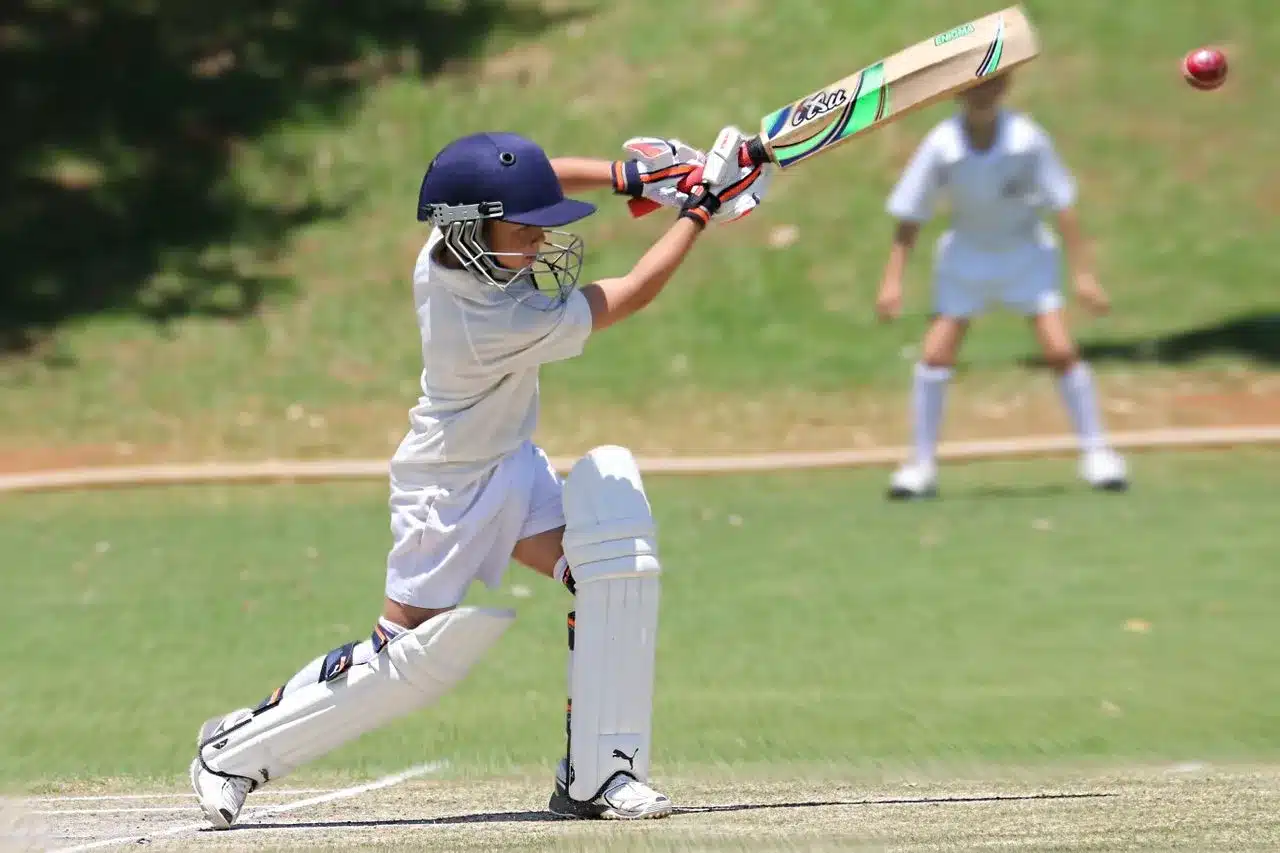
Cricket is one of the most-watched sports on the planet, followed by hundreds of millions of fans from India and Pakistan to England, Australia and the Gulf. To a newcomer, though, it can look baffling: games that last five days, scores like 287/6, and terms like “LBW” and “maiden over”.
The good news is that the basic idea is simple. This guide explains how cricket works, from the pitch to the ways a batter can get out, and the differences between Test, ODI and T20 cricket.
The basic idea
Two teams of 11 players take turns to bat and to bowl.
- The batting team tries to score as many runs as possible.
- The bowling (fielding) team tries to get the batters out and stop them scoring.
Each team’s turn to bat is called an innings. When it ends, the teams swap roles. The team with the most runs at the end wins.
The pitch and the wickets
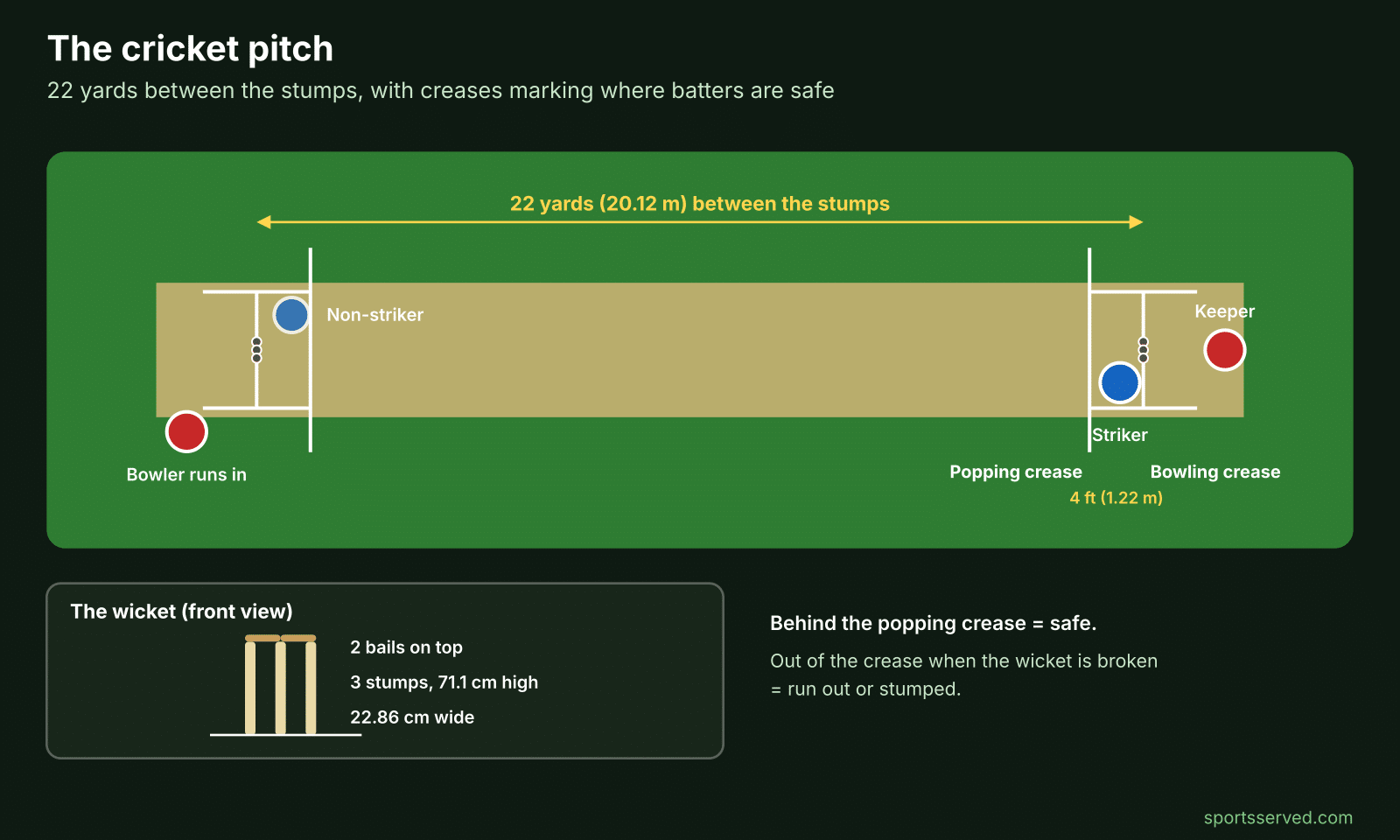
The game centres on the pitch, a strip of short grass 22 yards (20.12 m) long in the middle of a large, roughly oval field.
At each end of the pitch stands a wicket: three wooden stumps with two small bails resting on top. White lines called creases are painted in front of each wicket. The most important is the popping crease, 4 feet (1.22 m) in front of the stumps: a batter standing behind it is “safe in their ground”.
Batting: how runs are scored
Two batters are on the field at any time, one at each end. The batter facing the bowler is the striker.
Runs are scored in three main ways:
- Running: after hitting the ball, both batters run to the opposite end. Each time they swap ends safely, they score one run.
- Four: the ball crosses the boundary rope after touching the ground. Four runs, no running needed.
- Six: the ball clears the boundary without bouncing. Six runs.
The bowling side can also give away extras, runs not scored off the bat. The most common are a wide (a ball too far from the batter to hit) and a no-ball (usually the bowler overstepping the crease). Both add one run and the ball must be bowled again.
Bowling: overs
The bowler runs in and delivers the ball overarm, with a straight arm, usually bouncing it once before it reaches the batter.
Bowling is organised into overs: sets of six legal deliveries. After each over, a different bowler takes over from the other end. No bowler may bowl two overs in a row.
An over in which no runs are scored off the bowler is called a maiden.
How a batter gets out
A batter who is out is “dismissed” and replaced by the next batter. The most common ways to get out:
- Bowled: the ball hits the stumps and knocks off a bail.
- Caught: a fielder catches the ball after the batter hits it, before it touches the ground.
- LBW (leg before wicket): the ball would have hit the stumps but hits the batter’s leg (or body) instead. There are extra conditions about where the ball pitched and hit.
- Run out: a fielder breaks the wicket while the batters are running and out of their ground.
- Stumped: the wicketkeeper breaks the wicket while the batter has stepped out of their ground to play a shot.
- Hit wicket: the batter knocks off the bails with their own bat or body.
There are a few rare ones too, such as obstructing the field or being timed out for taking too long to come in.
An innings ends when 10 batters are out (the last one is left “not out”, because batting is done in pairs) or when the agreed overs run out.
Fielding positions
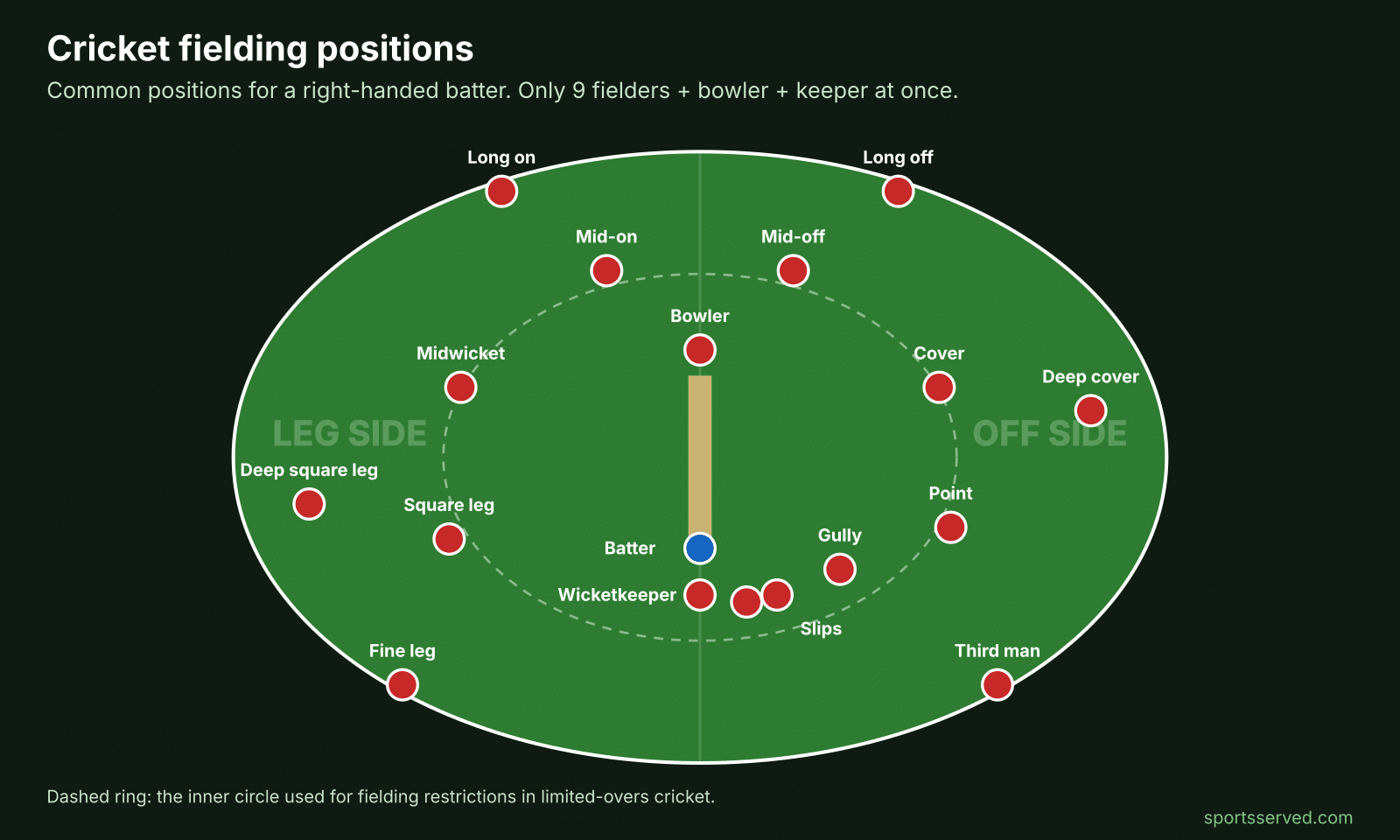
The captain places nine fielders around the field (plus the bowler and wicketkeeper) to stop runs and take catches. The field is split into the off side (the side the batter faces) and the leg side (behind their legs).
Test vs ODI vs T20: the three formats
| Format | Overs per innings | Innings per team | Typical length | Can end in a draw? |
|---|---|---|---|---|
| Test | Unlimited | 2 | Up to 5 days | Yes |
| One Day International (ODI) | 50 | 1 | About 8 hours | No |
| Twenty20 (T20) | 20 | 1 | About 3.5 hours | No |
- Test cricket is the original international format. Each team bats twice. If the side batting last isn’t all out when time runs out, the match is a draw.
- ODIs are one-day matches. The Cricket World Cup is played in this format.
- T20 is the fastest format, built for big hitting and evening crowds. It powers franchise leagues like the IPL.
How the result is described
You’ll often see results like “won by 45 runs” or “won by 6 wickets”:
- If the team that batted first wins, the margin is in runs (how many more runs they scored).
- If the team batting second wins, the margin is in wickets (how many batters were still not out when they passed the target).
A score written as 287/6 means 287 runs for the loss of 6 wickets. (In Australia it is written the other way round: 6/287.)
FAQ
How many players are in a cricket team?
Eleven. Only two batters from the batting team are on the field at once, while all 11 fielding players are on the field.
How long does a cricket match last?
It depends on the format: about 3.5 hours for T20, about 8 hours for an ODI, and up to five days for a Test match.
What is an over in cricket?
A set of six legal deliveries bowled by one bowler from one end. Wides and no-balls don’t count towards the six.
What does LBW mean?
Leg before wicket. A batter is out LBW if the ball would have hit the stumps but was stopped by their leg or body, subject to conditions about where it pitched and hit them.
Why can a Test match end in a draw after five days?
Because a team must bowl the opponents out twice to win. If time runs out before that happens, neither side has won.
What is a duck?
When a batter is out without scoring a run.