
Ask any fan what the number 9 means and they’ll say “striker”. Number 10? The playmaker. Number 1? The goalkeeper. But football didn’t always have shirt numbers at all, and the numbers you see today work very differently from the ones in your grandparents’ day.
Here’s how football shirt numbers began, what the traditional numbers mean, and why players now wear numbers like 47 or 99.
Football before numbers
For the first decades of organised football, players wore no numbers. Spectators and reporters simply had to recognise them. That was manageable in small grounds, but as crowds grew and newspapers and radio covered matches in more detail, it became a real problem.
The first numbered matches
Historians trace the earliest numbered shirts to Australia, where teams in Sydney wore numbers as early as 1911.
In English league football, the landmark date is 25 August 1928. On the opening day of the season, Arsenal wore numbers away at Sheffield Wednesday, and Chelsea did the same at home to Swansea Town. Arsenal’s game kicked off first, so their centre-forward Jimmy Brain is often credited as the first number 9 in English football.
Despite this, the Football League rejected numbering for another decade. It finally made numbers compulsory in 1939, with each team wearing 1 to 11 according to position.
What the traditional numbers mean
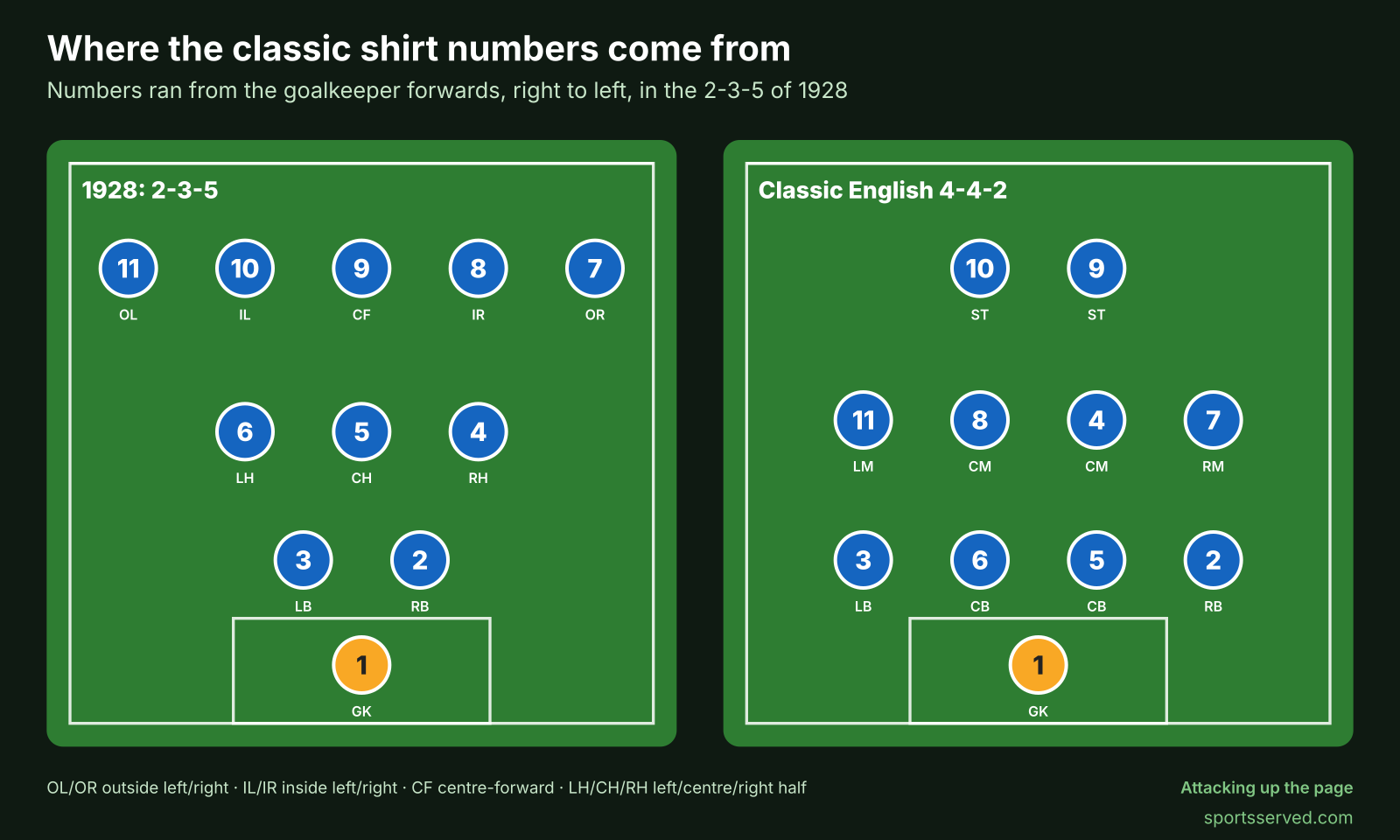
In 1928 most teams played a 2-3-5 formation, and the numbers simply ran from the back to the front, right to left:
| Number | Position in 2-3-5 | Typical modern role |
|---|---|---|
| 1 | Goalkeeper | Goalkeeper |
| 2 | Right-back | Right-back |
| 3 | Left-back | Left-back |
| 4 | Right half | Defensive or central midfielder |
| 5 | Centre half | Centre-back |
| 6 | Left half | Centre-back or holding midfielder |
| 7 | Outside right | Right winger |
| 8 | Inside right | Central midfielder |
| 9 | Centre-forward | Striker |
| 10 | Inside left | Playmaker / second striker |
| 11 | Outside left | Left winger |
As formations changed, the players moved but the numbers stuck to roughly the same roles. That’s why the 9 is still the striker and the 10 is still the creative attacker who plays behind them.
Regional differences
Not every country numbered the same way. In Brazil, for example, the 6 traditionally belongs to the left-back and the 3 to a centre-back, the opposite of the British habit, while the 5 is the classic defensive midfielder.
The famous numbers
- No. 1: the goalkeeper. Backup keepers often wear 12, 13 or higher.
- No. 7: the winger, made iconic by players such as George Best, David Beckham and Cristiano Ronaldo.
- No. 9: the centre-forward, the out-and-out goalscorer.
- No. 10: the most famous number of all, worn by Pelé, Diego Maradona and Lionel Messi. It belongs to the team’s most creative attacking player.
The arrival of squad numbers
Until the 1990s, numbers changed match by match: whoever started at right-back wore 2, and substitutes wore 12 and 14.
That changed with squad numbers. Each player gets one number for the whole season, printed with their name above it. The Premier League introduced them in 1993–94, its second season, after they were first used in the League Cup and FA Cup finals the previous spring. Most of Europe’s top leagues followed within a few years.
Squad numbers made it easier to sell replica shirts with a player’s name and number, and they gave players the chance to pick personal or lucky numbers. That’s why you now see numbers like 23, 47 or 99.
International tournaments
At the World Cup, squads have long been required to number their players 1 to 23 (now 1 to 26, matching the bigger squads), with the 1 reserved for a goalkeeper. Players keep the same number for the whole tournament.
FAQ
Why does the striker wear number 9?
Because in the 2-3-5 formation used when numbers were introduced, the centre-forward was the ninth player counting from the goalkeeper. The number stayed with the role.
Why is the number 10 so special?
It traditionally belongs to the team’s most creative attacking player and was worn by legends such as Pelé, Maradona and Messi.
When did football shirts first have numbers?
The first recorded numbered match was in Sydney in 1911. In English league football it was 25 August 1928, when Arsenal and Chelsea both wore numbers.
When were squad numbers introduced?
The Premier League introduced fixed squad numbers with names in the 1993–94 season.
What is the highest number a player can wear?
It depends on the competition. Most leagues limit squad numbers to 99.
Why do goalkeepers wear number 1?
Because when numbering began, players were numbered from the back of the team to the front, starting with the goalkeeper.